


Boiler Black Smoke Causes and How to Fix It Properly in Real-World Operations
Standing at the foot of the stack, looking up at a thick black streak pouring out… it really grinds your gears. It feels like you’re just shovelling the factory’s money out of the window. Any veteran in boiler operation knows this feeling well. You’re half-worried about the environmental inspectors knocking on the door, and half-furious because you know the boiler is running rough and efficiency is tanking.
Standing at the foot of the stack, looking up at a thick black streak pouring out… it really grinds your gears. It feels like you’re just shovelling the factory’s money out of the window. Any veteran in boiler operation knows this feeling well. You’re half-worried about the environmental inspectors knocking on the door, and half-furious because you know the boiler is running rough and efficiency is tanking.
To put it plainly, boiler black smoke means incomplete combustion. It doesn't matter if you're burning oil, coal, wood, or biomass. If you feed fuel into the combustion chamber and it doesn’t burn completely, it turns into soot and flies out the stack.
That’s when the boiler is "choking."
The damage is obvious. Environmental fines come later, but the immediate hit is fuel waste. The thing I fear most is soot fouling the fire tubes. Even a paper-thin layer of soot destroys your heat transfer. The flue gas temperature spikes, the boiler struggles to build pressure, and I end up having to bust my hump punching tubes at the end of the shift.
The Most Common Causes
Textbooks list a million reasons, but out on the floor, I find the causes of boiler black smoke usually revolve around just a few things:
1. Air Starvation (Lack of Oxygen):
This is the most common culprit. To burn, you need oxygen. Sometimes operators are scared that too much air will cool down the furnace, so they choke the dampers or drop the fan frequency too low. If you close it off too much, the fuel can't find enough air to burn. Other times, the forced draft (FD) fan is weak, or the air filters are clogged with dirt and nobody noticed, so the air isn't even getting to the chamber.
2. Fuel Issues (Too Much or Poor Quality):
For an oil-fired industrial boiler: Low atomizing pressure or a worn-out burner nozzle. If the nozzle tip is worn or the hole is oval, the oil doesn't atomize into a mist; it spits out big droplets or sprays sideways. Even with good air, that oil won't burn fast enough. For coal or chain grate boilers: The coal bed is too thick. If the under-grate air can't punch through that thick layer of coal, how’s it going to burn? Or maybe the coal is soaking wet (high moisture)—your furnace temp drops, and black smoke is guaranteed.

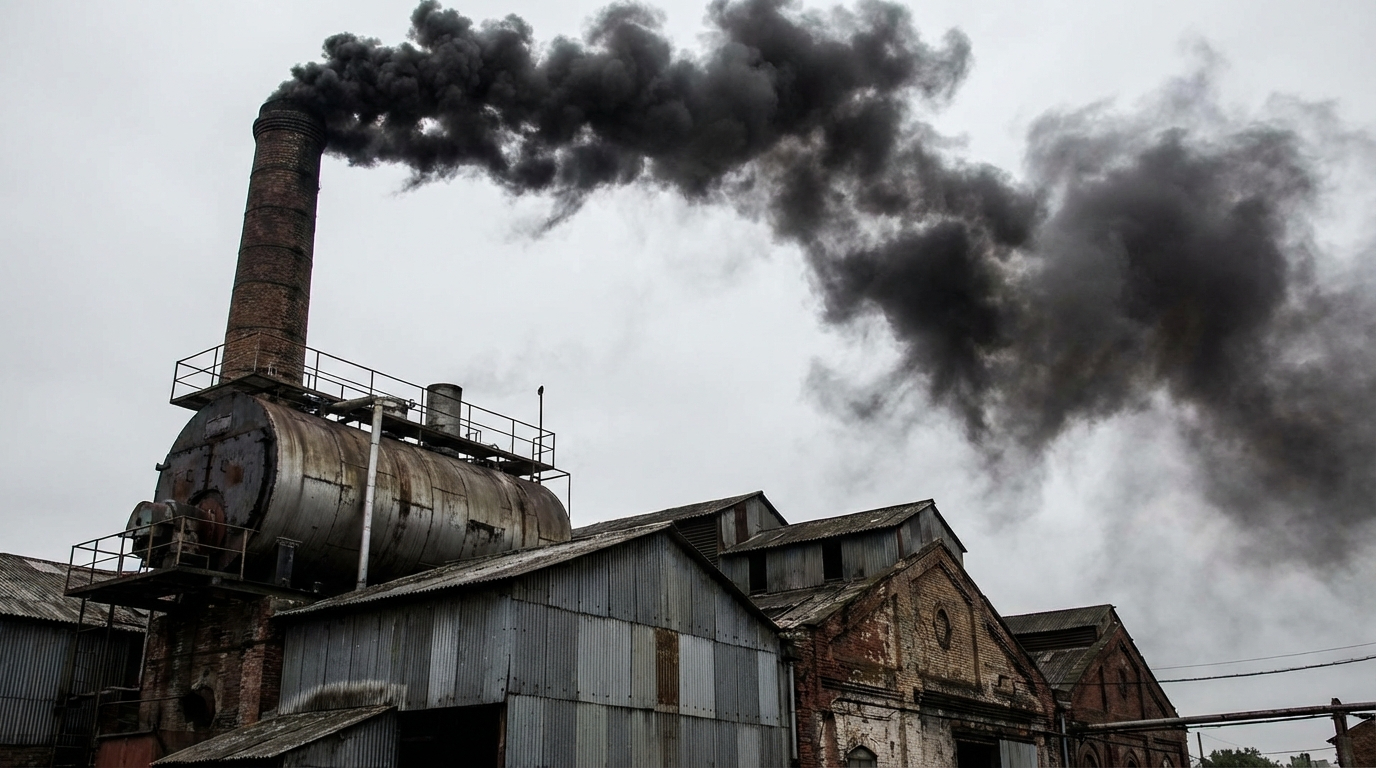
Industrial boiler stack spewing black smoke due to incorrect air-fuel ratio (Photo: Long Huynh)
3. Overloading or a Cold Furnace:
Sometimes the factory needs steam now, and the boys push the boiler past its design capacity. You're dumping fuel in, but the combustion chamber volume is fixed. There isn't enough residence time for it to burn. Or, during a cold start, if you rush the firing rate while the refractory walls are still cold, you’ll generate smoke.
How to Fix It: From Quick Fixes to Root Causes
If you see black smoke, act fast. Let it run too long and the soot buildup will make your life miserable.
The Hot Fix (Do it right now):
First thing: Check the air. Ramp up the air supply slowly. As you increase it, look through the sight glass. The most effective way regarding how to fix boiler black smoke is reading the flame. The flame should be bright, a vibrant orange or lemon yellow, filling the furnace. If it looks dark red, dull, with black streaks swirling inside, you are severely starving it of air.
If burning oil: Check your oil preheat temperature (for heavy oil). If the oil is too cold, the viscosity is too high, and it won't mist properly. Bump the temp up a notch.
If burning coal: Slow down the chain grate or lower the gate to thin out the coal bed. Don't be greedy and try to stuff more coal in right now.
The Deep Fix (During downtime):
At the end of the shift or during maintenance, pull that burner nozzle out. This is where many people go wrong—they think nozzles last forever. They don't. A microscopic bit of wear on the orifice ruins the spray pattern. Just replace the nozzle. It costs peanuts compared to the money you're burning in wasted oil.
Clean the fan blades and check the housing. Make sure dust isn't choking your airflow. Punch and clean the fire tubes and water tubes thoroughly.

Checking flame colour through the sight glass to adjust air (Photo: Operating Documents)
A Deadly Mistake to Avoid
I’ve seen this happen. An operator sees black smoke, panics, and cranks the air fan to 100% to clear it. Sure, the black smoke stops, and the stack looks clear. But if you look closer, you might see white smoke or just heat shimmer, and your stack temperature is sky-high. That is excess air. You’re blowing way too much air in, which grabs the heat and carries it straight out the chimney before it can transfer to the water. The boiler burns fuel like crazy, but the pressure won't rise.
So, in this trade, balance is everything. Adjust the air so the smoke is a very faint, light grey haze. That’s the sweet spot—complete combustion without massive excess air.
Don't trust the gauges blindly; sensors fail. Trust your eyes and the "roar" of the flame. When you run boilers long enough, you know that steady, rhythmic "thrum-thrum" sound means the boiler is healthy.
Just a few thoughts from the floor. If you're on shift and see smoke, go adjust that damper now.
If your business is struggling with black smoke issues during boiler operation, contact Hong Nhut immediately. As a leading unit in investment, construction, and professional boiler operation, we are ready to advise and provide rapid, effective, and sustainable solutions.
Related Articles
- Khởi động và ngừng lò hơi đúng quy trình tránh sốc nhiệt (30/07/2026)
- Van an toàn, áp kế, relay mức nước: 3 vệ sĩ của nồi hơi (16/07/2026)
- Nồi hơi cho ngành chế biến thủy sản: cấp hơi hấp, sấy, tiệt trùng ổn định (06/07/2026)
- Hồ sơ kiểm định an toàn nồi hơi cuối năm: cần chuẩn bị gì? (01/07/2026)
- Cách tính công suất nồi hơi theo nhu cầu thực tế (24/06/2026)
Latest News


