


The Hidden Costs of an Aging Boiler: Why Your Plant Is "Burning Money" Without Knowing It
Many Vietnamese businesses, particularly in Binh Duong and Dong Nai, continue to defer boiler upgrades because they cannot clearly see the long-term Total Cost of Ownership (TCO). In reality, outdated boilers with low thermal efficiency are consuming billions of dong in fuel and maintenance costs every year. Investing in modern technology, while costly upfront, typically delivers a rapid break-even point and significant profit gains through energy savings, reduced risk, and improved production stability.
"Boss, why did our gas/oil bill spike so much this month?", I hear this constantly from maintenance managers at the plants I visit, especially when they are running boilers that are decades old. They stare at the fuel invoice, worried, yet very few ever dig down to the root cause: could the "old" equipment be silently burning through company money every single month without anyone realizing it?
How Much Money Is Your Aging Boiler Burning Every Year?
An aging boiler, with outdated technology and low thermal efficiency, can cost your plant billions of dong annually through inflated fuel expenditure and continuous maintenance. The exact magnitude of the loss depends on plant scale, fuel type, and the maintenance condition of the equipment.
I once worked with a textile plant in Binh Duong. They operated an aging chain grate boiler with a steam generation capacity of 5 TPH (tons per hour). Simply put, 5 tons of steam per hour is sufficient to supply a fairly large production line. Working pressure was 8 bar, a very high steam pressure, roughly equivalent to the force of a heavy truck bearing down on the palm of your hand. Initially, everyone thought "just patch it up and save the cost." But once we sat down and ran the numbers, everything became very clear.
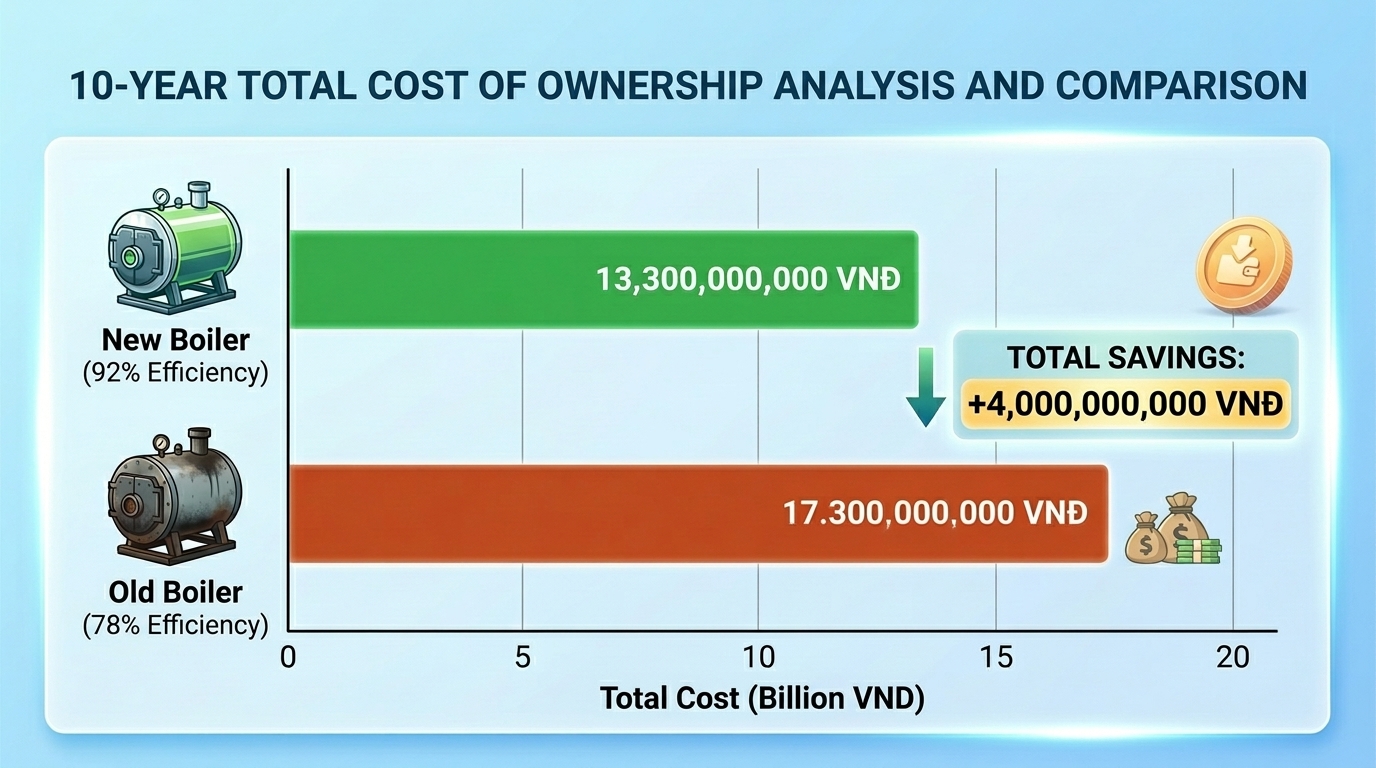
The table below compares estimated operating costs over 10 years between an aging boiler (78% efficiency) and a new boiler (92% efficiency), based on actual industrial gas prices in Vietnam for Q1/2025 (internal estimates from market reports):
| Cost Item | Aging Boiler (78% Efficiency) | New Boiler (92% Efficiency) | Difference/Year |
|---|---|---|---|
| Fuel cost (Gas/FO heavy fuel oil) | 15,000,000,000 VND | 12,600,000,000 VND | +2,400,000,000 VND |
| Maintenance and repair cost | 1,200,000,000 VND | 400,000,000 VND | +800,000,000 VND |
| Feedwater treatment cost | 300,000,000 VND | 200,000,000 VND | +100,000,000 VND |
| Losses from unplanned downtime | 800,000,000 VND | 100,000,000 VND | +700,000,000 VND |
| Total cost over 10 years | 17,300,000,000 VND | 13,300,000,000 VND | +4,000,000,000 VND |
Fuel costs alone show that a new boiler saves 2.4 billion VND per year. Over 10 years, the cumulative cost differential reaches 4 billion VND, and this figure does not include intangible losses.
What Invisible "Cost Leaks" Are Quietly Draining Your Budget?
Beyond fuel, there are many other "holes" that an aging boiler creates. These leaks do not show up clearly on monthly invoices, yet they cause serious financial haemorrhage.
1. Thermal Losses Through Degraded Insulation and Non-Automatic Blowdown
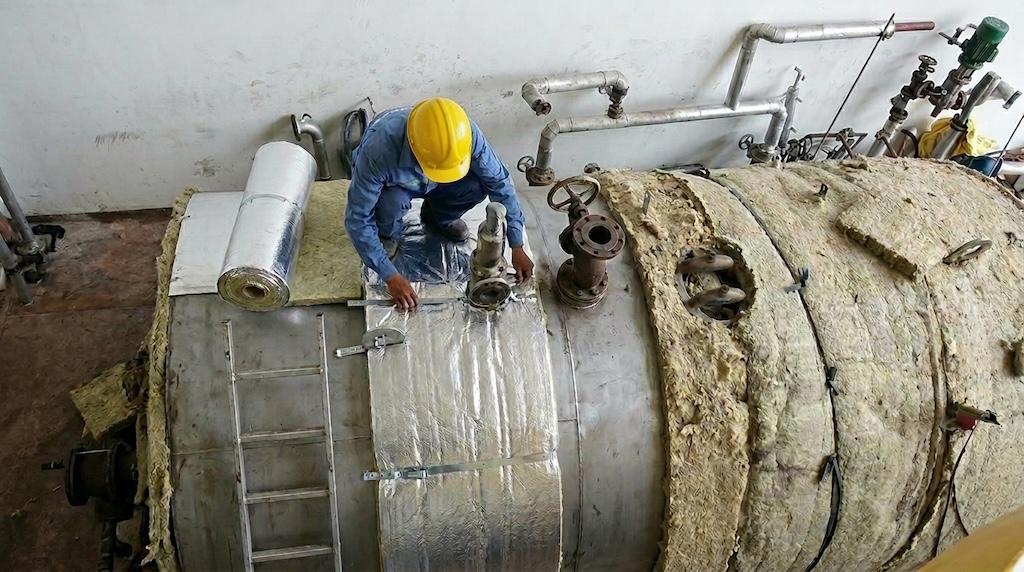
Aging boilers typically have deteriorated thermal insulation (lagging). This is like wearing a tattered jacket in the cold, heat escapes outward, wasting energy. In Vietnam, particularly in workshops in Binh Duong and Dong Nai with a hot and humid climate, poor insulation also adds to the cooling load on the workshop's air handling systems. Every degree Celsius of heat loss is money evaporating.
The second issue is blowdown. Boilers require periodic blowdown to remove scale deposits, mineral accumulations similar to limescale in a household kettle. When scale builds up, it reduces heat transfer efficiency, forcing you to burn more fuel to generate the same amount of steam. The manual blowdown systems on aging boilers are rarely optimal: either they discharge too much hot steam (wasteful) or too little, allowing scale to accumulate faster. Modern boilers with automatic blowdown systems strike the right balance, discharging only the necessary volume and minimizing thermal losses.
2. Overload Operation Due to Incorrect Sizing and Unstable Grid Supply
Many aging boilers were installed long ago when production scale was smaller. As the plant has since expanded and steam demand has grown, the boiler is forced to "strain" beyond its design capacity or operate in a non-optimal regime. This is like driving a manual transmission car but always stuck in a low gear, fuel consumption is far higher than it needs to be.
Another issue specific to Vietnam is voltage sag on the power grid. Modern boilers are equipped with intelligent control systems that can better adapt to voltage fluctuations, ensuring stable and efficient combustion. Aging boilers are far more susceptible, causing operational interruptions or degraded combustion efficiency, both of which drive higher fuel consumption.
How a Textile Plant in Binh Duong Saved 1.8 Billion VND/Year by Upgrading Its Condensate Heat Recovery System
A textile plant in the Song Than 2 Industrial Zone, Binh Duong, made the bold decision to invest in upgrading its condensate heat recovery system. This system captures hot water from steam that has already transferred its heat to the production process, then returns it to the boiler. Previously, the plant was discarding most of this condensate, wasting both water and thermal energy.
We advised them to install a closed-loop condensate recovery system and return the condensate to the boiler. The result: boiler feedwater temperature increased from approximately 40°C to 85–90°C. This means the boiler no longer needs to burn as much fuel to heat water from cold. They achieved close to a 15% reduction in monthly fuel consumption. After accounting for the initial capital investment, the plant saved an estimated 1.8 billion VND per year, a significant figure that can be reinvested into other plant initiatives or directly contribute to profit.
This upgrade also reduced the volume of feedwater requiring chemical treatment, extended equipment service life, and lowered the risk of scale buildup. One investment, multiple benefits.
The Formula for Calculating the Break-Even Point on a Boiler Upgrade Investment
To help CFOs (Chief Financial Officers) and business owners calculate this easily, I offer a simple formula for determining when a boiler upgrade investment reaches its break-even point and begins generating returns. This is the pivotal number for making a sound decision.
Break-Even Point (years) = Upgrade Capital Cost ÷ (Annual Fuel Savings + Annual Maintenance Cost Reduction + Annual Downtime Loss Reduction)
Example: If you invest 5 billion VND in an upgrade, and each year you save 2.4 billion VND in fuel, reduce maintenance costs by 800 million VND, and reduce downtime losses by 700 million VND (total savings of 3.9 billion VND/year):
Break-Even Point = 5,000,000,000 ÷ (2,400,000,000 + 800,000,000 + 700,000,000) = 5,000,000,000 ÷ 3,900,000,000 ≈ 1.28 years
In just over one year, your capital investment is fully recovered. From that point forward, the optimized system generates close to 4 billion VND in net profit every year, a compelling return for any business.
Recommendations
- Don't evaluate costs in isolation: Look at the Total Cost of Ownership (TCO) over the next 5–10 years. What appears to be "savings" from ongoing repairs is, in fact, a long-term money drain.
- Assess the system holistically: Don't focus on the boiler alone. Examine the entire system, pipework, condensate recovery, feedwater treatment, and control systems. Only a fully integrated and synchronized system delivers optimal efficiency.
- Consult experienced specialists: Every plant has its own characteristics. A consultant with real-world field experience will give you a precise analysis and lay out the most effective upgrade roadmap suited to your specific financial and production situation. Contact us for boiler solution consulting.
Conclusion
The time has come for business owners and maintenance managers to face the truth: an aging boiler is not just a cost burden, it is a latent risk to production operations. Deferring the upgrade investment only means forfeiting billions of dong in profit and growth opportunities. Act now to transform this "burden" into a value-generating asset.
CONTACT INFORMATION:
Company: HONG NHUT THERMAL & REFRIGERATION ENGINEERING CO., LTD
Hotline/Zalo: 0961546854
Email: [email protected]
Website: https://hongnhut.com/
Address: 117A Binh Thoi Street, Phu Tho Ward, Ho Chi Minh City
Factory Address: 150C Ho Hoc Lam Street, An Lac Ward, Ho Chi Minh City
Related Articles
- Khởi động và ngừng lò hơi đúng quy trình tránh sốc nhiệt (30/07/2026)
- Van an toàn, áp kế, relay mức nước: 3 vệ sĩ của nồi hơi (16/07/2026)
- Nồi hơi cho ngành chế biến thủy sản: cấp hơi hấp, sấy, tiệt trùng ổn định (06/07/2026)
- Hồ sơ kiểm định an toàn nồi hơi cuối năm: cần chuẩn bị gì? (01/07/2026)
- Cách tính công suất nồi hơi theo nhu cầu thực tế (24/06/2026)
Latest News


