


What Is a Combined Heat and Power (CHP) System and Why Does It Matter?
In today's highly volatile energy landscape, a boiler-integrated Combined Heat and Power (CHP) system is the key that enables large enterprises in Vietnam to achieve energy independence in both electricity and heat, minimizing the risks of rolling blackouts and escalating energy bills. This solution not only optimizes fuel utilization efficiency but also opens a sustainable path toward energy security for the plant.
Every summer, EVN's rolling blackout schedules deliver a punishing blow to production batches in mid-run at factories across the country. Grid voltage sag, combined with energy costs (both electricity and steam) consuming an excessively large share of product cost, is steadily eroding the export competitiveness of Vietnamese businesses. With over a decade of hands-on experience alongside manufacturing plants, I understand this struggle intimately. The time has come for an energy independence solution.
What Is a Combined Heat and Power (CHP) System and Why Does It Matter for Vietnamese Businesses?
A Combined Heat and Power (CHP) system — also known as cogeneration — is an integrated energy solution in which electricity and heat are produced simultaneously from a single fuel source. For Vietnam, where the climate is hot and humid and the power grid is unreliable, CHP enables plants to take control of their energy supply, maximize the utilization of every unit of fuel, convert thermal "waste" into valuable electricity and process steam, ensure continuous production, and stabilize costs.
Think of it this way: your plant needs both electricity to run machinery and steam for drying or heating products. Conventionally, you purchase electricity from EVN and fire a separate boiler to generate steam — two independent processes, with the energy from power generation typically lost as waste heat. A CHP system, or cogeneration boiler, completely changes the equation. We design a high-pressure boiler in which the hot, high-energy steam produced is directed through a steam turbine to drive a power generator. It is analogous to blowing air onto a pinwheel to make it spin and generate electricity — but at industrial scale, with superheated steam.
The remarkable feature is that after the steam has "done its work" spinning the turbine, its pressure and temperature drop but remain high enough to continue serving other production processes in the plant — such as drying agricultural products, heating chemical tanks, or supplying steam to a central HVAC system. Instead of discarding the waste heat from power generation, we put it to productive use. This is the cornerstone of the extraordinary combined efficiency that CHP systems routinely achieve — often reaching 80% or higher — far exceeding conventional standalone power generation (typically only 30–40%) combined with a separate traditional boiler.
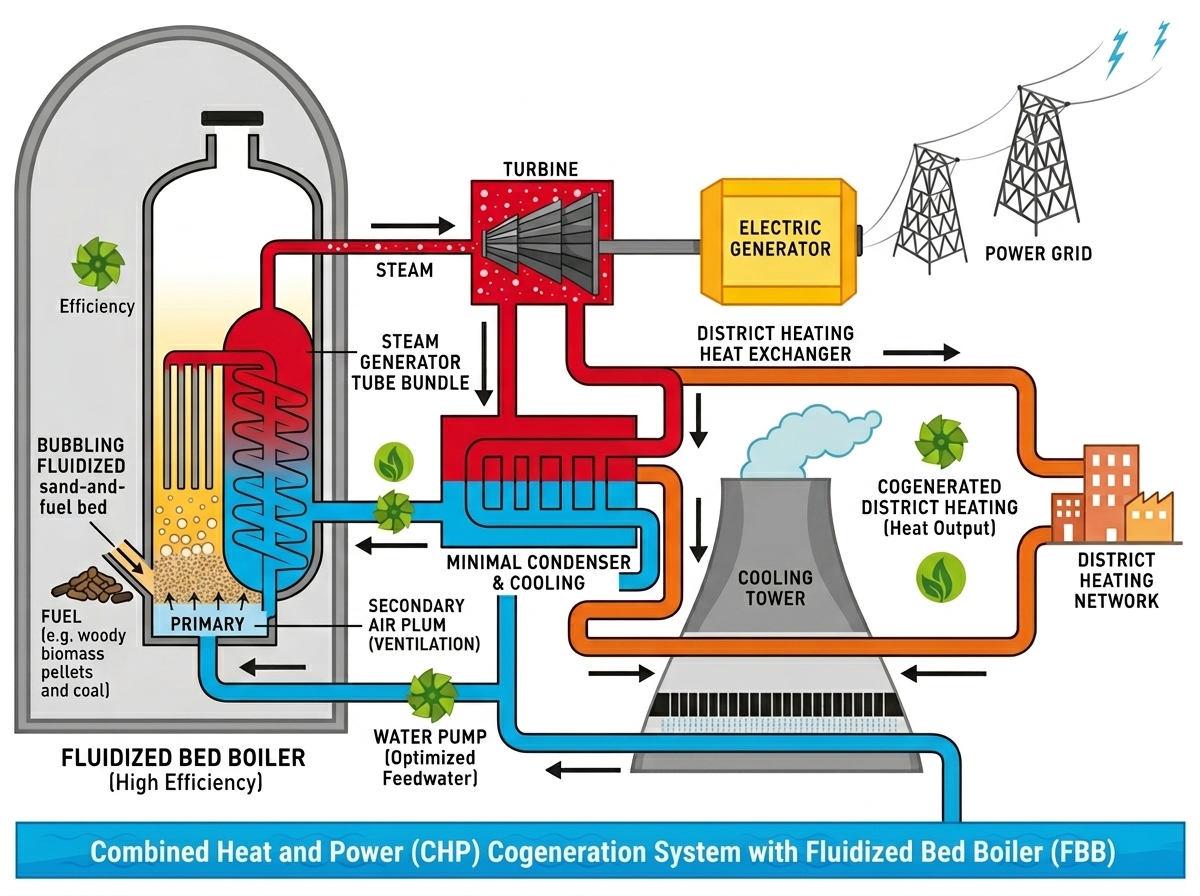
Components and Operating Principle of a Boiler–Turbine CHP System
A boiler-integrated CHP system is a sophisticated assembly of multiple components, each playing an essential role in ensuring performance and reliability. I have been directly involved in the design and installation of many such systems, from large paper mills to food processing facilities.
Key Components
- High-pressure power generation boiler: This is the heart of the system. Unlike a conventional boiler that generates steam solely for production processes, a CHP boiler is engineered to withstand extremely high pressures and temperatures (for example, 60–100 bar, 450–540°C). Fuel sources can be diverse, ranging from coal, oil, and gas to biomass (bagasse, rice husks). The choice of boiler type (chain grate, fixed grate, fluidized bed) depends on the fuel type and capacity requirements.
- Steam turbine: Superheated steam from the boiler is directed into the turbine, driving the rotation of large turbine blades. The turbine is directly coupled to a power generator. Depending on steam and electricity demand, either an extraction turbine (which allows steam to be extracted at multiple pressure levels) or a back-pressure turbine (in which all exhaust steam discharged from the turbine is directed to production heat users) may be used.
- Steam turbine generator: This component converts the mechanical energy from the turbine into electrical energy. Generator output is typically rated in Megawatts (MW).
- Feedwater treatment system: This is an absolutely critical element that many overlook. Boiler feedwater must be treated to an extremely high standard — with complete removal of scale (mineral accumulations similar to limescale in a kettle) — to prevent tube damage and efficiency degradation. Without proper treatment, the boiler will within a short period suffer from water hammer (condensate-steam mixture creating violent impacts) or even explosion due to localized pressure buildup.
- Control and protection system: Ensures the entire system operates safely, stably, and efficiently. Includes safety valves, pressure sensors, temperature sensors, and related instrumentation.
Summary of Operating Principle
- Treated water is pumped into the boiler.
- The boiler fires fuel to heat the water into superheated steam at high pressure and temperature.
- The superheated steam enters the turbine, driving turbine rotation and the generator to produce electricity.
- Steam exhausted from the turbine (extracted steam or back-pressure exhaust steam) is routed to heat-consuming processes in the plant (e.g., drying, process heating).
- After heat exchange, the steam condenses back into water and is returned to the boiler, completing a closed-loop cycle.
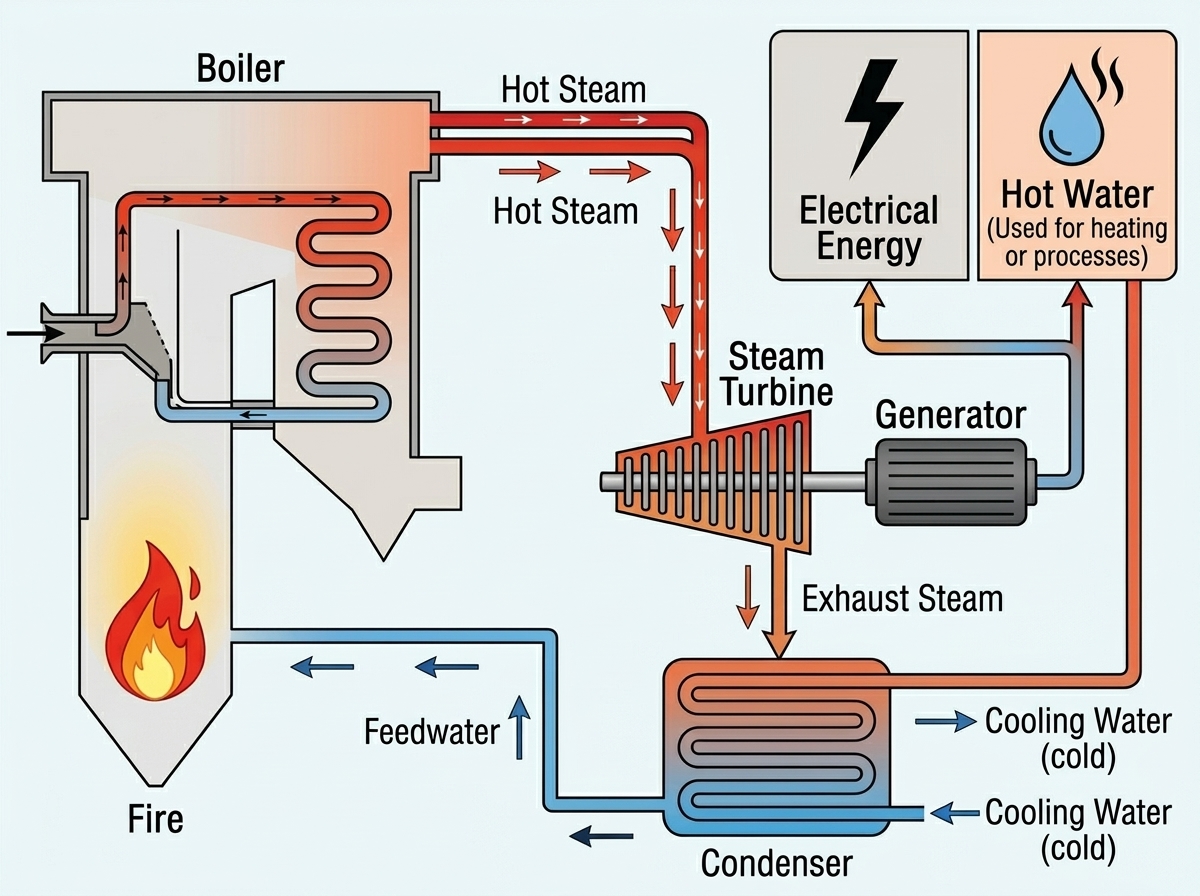 Cogeneration system using steam turbine. (Image: Hong Nhat)
Economic Efficiency and Strategic Benefits of a CHP System
I have witnessed countless businesses waste billions of dong every year simply by failing to utilize energy efficiently. A CHP system is not merely a technical solution — it is a strategic decision that delivers outstanding economic benefits and energy security.
Comparison: Conventional Energy Model vs. CHP Cogeneration Model
| Criteria | Conventional Model (Grid Electricity + Separate Boiler) | CHP Cogeneration Model |
|---|---|---|
| Overall fuel utilization efficiency | 45–55% (Electricity: ~35%, Heat: ~70%) | 75–90% |
| Energy cost | Entirely dependent on EVN electricity tariffs and separate boiler fuel prices. Highly volatile. | Significantly reduced through self-generated electricity and heat recovery. More stable. |
| Energy security | High risk from blackouts, voltage sag, dependency on the national grid. | Electricity self-sufficiency — ensures continuous operation even during grid failures. |
| CO₂ emissions | Higher due to lower overall efficiency — more fuel must be burned to deliver the same total energy output. | Lower due to optimized fuel utilization. |
| Payback period | Not applicable — ongoing electricity and steam purchase costs. | Typically 3–7 years, depending on system scale and fuel prices. |
Practical Applications in Vietnam: Bright Examples from the Sugar and Paper Industries
In Vietnam, energy-intensive industries such as sugarcane processing, paper and pulp, textiles, and chemicals are ideal candidates for CHP systems. I have seen sugarcane mills utilize bagasse as fuel for fluidized bed boilers to generate not only all the electricity the plant needs but also to sell surplus power back to the national grid during the crushing season. Similarly, paper mills that generate electricity from steam can still extract sufficient steam at intermediate pressure to efficiently dry paper — significantly reducing electricity costs and enhancing competitive positioning.
One of the greatest benefits — especially for large plants — is electricity self-sufficiency. Consider a large paper mill in Dong Nai that can weather localized rolling blackouts without interrupting a production line worth billions of dong per batch. The dream of energy independence for manufacturing plants is no longer out of reach.
Legal Framework and Power Purchase Mechanisms in Vietnam
Investing in a CHP system in Vietnam is not purely a technical matter — it is closely intertwined with the regulatory framework. The Vietnamese Government is currently taking positive steps to encourage the development of renewable energy and energy-efficient generation, including CHP.
The Direct Power Purchase Agreement (DPPA) mechanism is under active study and is expected to be broadly implemented in the near future. DPPA will allow power generators (including CHP systems) to sell electricity directly to large industrial consumers without routing through EVN. This opens a major opportunity for plants to fully exploit the capacity of their CHP systems — not just for self-consumption but as an additional revenue stream. Even under current regulations, self-generation for own consumption (generating electricity for on-site use and selling surplus to EVN) already delivers clear economic benefits, particularly given EVN's priority purchasing policy for electricity from renewable or efficient generation sources.
Critically, businesses need to thoroughly understand current regulations, grid interconnection standards, safety operating requirements, and available investment incentives. We continuously update our knowledge of this regulatory landscape to advise clients on the most compliant and cost-effective solutions, ensuring both legal compliance and long-term investment returns.
Key Considerations When Implementing a CHP System
Deploying a CHP system is not something accomplished overnight. It demands thorough analysis, expert engineering design, and real-world operational experience. Based on projects I have been directly involved in, here is some advice from the heart:
- Conduct a thorough demand analysis: Don't rush. Start by accurately profiling your plant's electricity and heat demand hour by hour and season by season. This is the foundation for correctly sizing the boiler and turbine — avoiding both over-investment and under-capacity.
- Make smart fuel choices: Vietnam has abundant biomass fuel resources. Utilizing bagasse, rice husks, and biomass pellets not only reduces costs but also contributes to environmental protection. However, each fuel type requires a different boiler technology.
- Prioritize equipment quality and installation workmanship: A CHP system designed to operate reliably for 20–30 years depends heavily on the quality of the core equipment (boiler, turbine, generator) and the standard of installation. Do not compromise on equipment quality to save on upfront cost. Scheduled, standards-compliant preventive maintenance is equally non-negotiable. Professional boiler maintenance services are a worthwhile investment.
The path to energy independence is not an abstract concept — it is a concrete course of action. Integrating a boiler into a Combined Heat and Power (CHP) system is a strategic move that delivers electricity self-sufficiency, optimizes production costs, and strengthens your enterprise's competitiveness in international markets.
If you are struggling with enormous energy bills or the anxiety of rolling blackouts, let us — with over three decades of hands-on field experience — work with you to find the answers. We understand the challenges and opportunities in Vietnam deeply.
CONTACT INFORMATION:
Company: HONG NHUT THERMAL & REFRIGERATION ENGINEERING CO., LTD
Hotline/Zalo: 0961546854
Email: [email protected]
Website: https://hongnhut.com/
Address: 117A Binh Thoi Street, Phu Tho Ward, Ho Chi Minh City
Factory Address: 150C Ho Hoc Lam Street, An Lac Ward, Ho Chi Minh City
Related Articles
- Khởi động và ngừng lò hơi đúng quy trình tránh sốc nhiệt (30/07/2026)
- Van an toàn, áp kế, relay mức nước: 3 vệ sĩ của nồi hơi (16/07/2026)
- Nồi hơi cho ngành chế biến thủy sản: cấp hơi hấp, sấy, tiệt trùng ổn định (06/07/2026)
- Hồ sơ kiểm định an toàn nồi hơi cuối năm: cần chuẩn bị gì? (01/07/2026)
- Cách tính công suất nồi hơi theo nhu cầu thực tế (24/06/2026)
Latest News


