


How to Calculate Boiler Exhaust Gas Flow Rate: Accurate and Practical Application Methods
I still remember vividly the feeling of standing frozen, watching the pressure gauge needle jump erratically, while the technical director was scratching his head in frustration—the exhaust fan was screaming like a train whistle, yet smoke stubbornly swirled inside the furnace, refusing to vent. The piercing alarm sound just kept ringing in my ears. Truly haunting.
The technical manager from a textile mill was screaming down the phone, sounding like he was about to cry: "Mate, you gotta save me. The new ID fan we just installed is weak as hell. Smoke is puffing back out the furnace door! My boss just tore strips off me."
I sighed and asked the million-dollar question: "So, when you picked that fan, how did you run the numbers for the flow rate?"
Silence.
"I... I just sort of eyeballed it based on the old boiler."
There it is. That’s how you kill a project. "Eyeballing it." In this game, guessing is the fastest way to lose your shirt—and your reputation. This story isn't rare; I’ve seen it a hundred times in my 20 years in the thermal game. People think you just buy a boiler, slap on a stack, hook up a fan, and you’re golden. Wrong.
The "lungs" of your factory—the system handling industrial boiler emissions—needs to breathe right. If the breath is too shallow, it chokes (backfire). Too hard, and you’re burning money on electricity and heat loss.
Today, let’s toss the textbooks in the bin. I’m going to show you how to calculate boiler emissions the "street smart" way. So you never end up like that guy on the phone.
Exhaust Flow Rate - Think of it as "Rhythm of Breath"
Let’s not overcomplicate this.
Imagine your boiler is a marathon runner. The faster it runs (higher capacity), and the more it eats (fuel), the harder it has to breathe (exhaust gas).
The boiler exhaust gas flow rate is simply the total volume of smoke, dust, steam, and excess air escaping up the stack per unit of time (usually calculated in m³/hr).
Why is this number a matter of life and death for your system?
-
Sizing the Induced Draft (ID) Fan: Get this wrong, and the fan is underpowered. The boiler won't burn. Period.
-
Designing the Scrubber/Cyclone: Velocity is everything. If the gas moves too fast, the dust doesn't settle—it flies right out the stack. Too slow? The dust clogs your ducts.
-
Environmental Reporting: The folks at the EPA or local environmental agencies need this number to track total pollution.
To put it bluntly, if you mess up this calculation, the entire downstream treatment system is garbage.

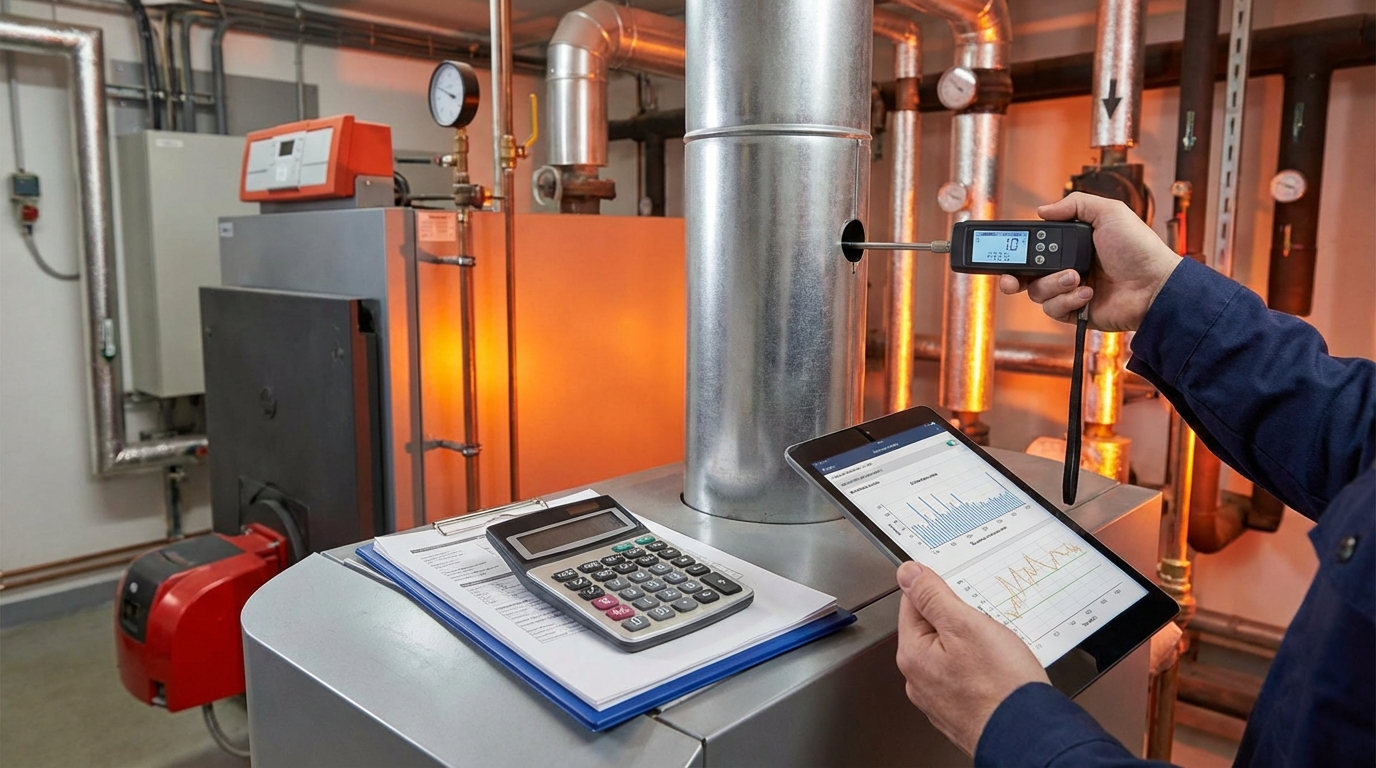
An engineer holding a Testo flue gas analyzer standing next to a smokestack. (Photo: Long Huỳnh)
The "Hidden Culprits" Skewing Your Numbers
To find a reliable flue gas calculation method, you have to look at the nature of what you're burning. There is no "one size fits all" formula for rice husks and anthracite coal.
There are three boogeymen that dictate this number:
-
Fuel Composition: Anthracite coal emissions are different from Indonesian coal, which is different from wood pellets. The wetter the fuel, the more gas you get (thanks to steam).
-
Excess Air Coefficient (Alpha): This is the silent killer. To burn fuel completely, we always feed in extra air. But how much? Too much, and your flow rate skyrockets, overloading the fan and dumping precious heat outside. Wasteful!
-
Temperature: Hot gas expands. A specific amount of gas at 400°F takes up way more space than it does at 70°F.
The "Back-of-the-Napkin" Formula for Field Engineers
Look, to be honest, if you pull out the stoichiometric charts and balance C, H, O, N, S, you’ll get a perfect number. But who has time for that on a muddy construction site? Operators need a quick number that’s 90-95% accurate to make a decision right then and there.
Here is the method for calculating boiler exhaust based on practical Rules of Thumb that we thermal engineers actually use.
The General Formula:
L = B \times V_{specific}
Where:
-
L: Total boiler exhaust gas flow rate (Nm³/h).
-
B: Fuel consumption (kg/h).
-
V_specific: Volume of gas produced when burning 1kg of fuel (Nm³/kg).
Reference Table for V_specific (Assuming Excess Air Coefficient \alpha \approx 1.3 - 1.4):
| Fuel Type | Estimated V_specific (Nm³/kg) | Note |
| Diesel (DO)/Fuel Oil (FO) | 11 - 13 | Most stable |
| Gas/LPG | 12 - 14 | Pretty clean |
| Coal (Indo) | 10 - 15 | Varies by caloric value |
| Anthracite Coal | 9 - 11 | Harder to burn |
| Wood/Biomass | 5 - 8 | Depends heavily on moisture |
Let's look at a Real-World Example:
Say your plant runs a 5-ton boiler burning Indonesian coal. It eats about 750kg of coal an hour.
So, the estimated flow rate at standard conditions is:
L = 750 \text{ (kg/h)} \times 12 \text{ (average)} = 9,000 \text{ Nm}^3/\text{h}.
THIS IS CRITICAL:
That 9,000 figure is Nm³ (Normal cubic meters) – at standard conditions (0°C, 1 atm).
But in reality, the gas leaving the tail of the boiler is roughly 180°C. At that heat, the actual flow rate expands massively.
Conversion Formula:
V_{actual} = V_{standard} \times \frac{273 + t}{273}
\text{With } t = 180^\circ C: V_{actual} = 9,000 \times \frac{273+180}{273} \approx 14,934 \text{ m}^3/\text{h}
See that? It went from 9,000 to nearly 15,000. If you sized your fan based on the 9,000 figure, you’re dead in the water. The fan won't have the guts to pull that volume.
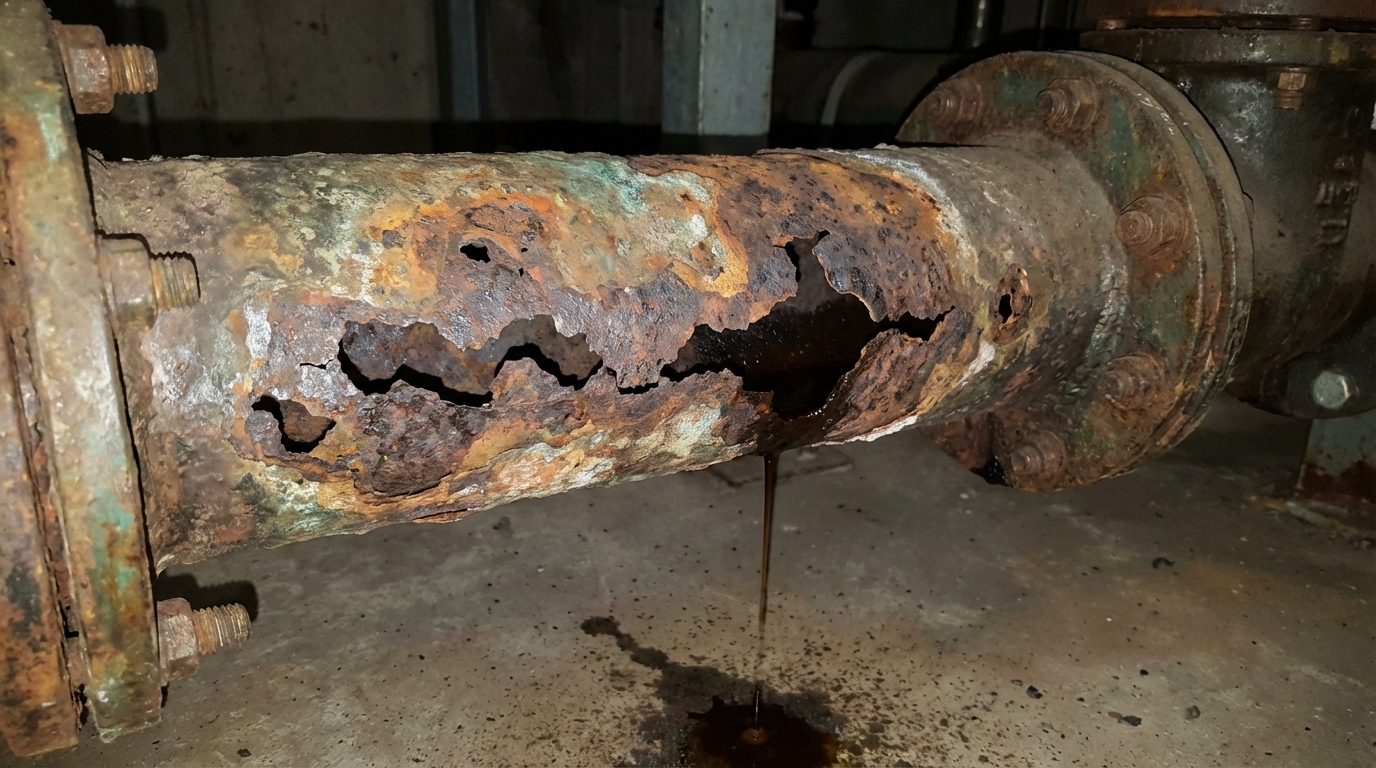
A section of exhaust ducting riddled with corrosion holes due to incorrect gas velocity calculation causing acid condensation (Photo: Collected)
"Blood and Tears" Mistakes to Avoid
I do a lot of consulting, and I see guys making the same three mistakes over and over again:
-
Confusing Nm³/h with m³/h: Just like the example above. The error margin is 1.5 - 1.6 times. The result? You buy the wrong fan and build a scrubber that’s too small.
-
Forgetting Fuel Moisture: Especially with wood-fired or sawdust boilers. If it rains and your wood gets soaked, the steam content in the smoke spikes. The boiler exhaust gas volume can jump 20-30%. If you didn't plan for that buffer, your fire dies.
-
Blind Faith in the Catalogue: Boiler specs are written for ideal laboratory conditions. Old boilers, scale buildup, reduced efficiency, and operators who crank up the air intake... all these things mean the real flow rate is always higher than the paper calculation.
Some Real Talk
If you are doing an EIA (Environmental Impact Assessment) report, go ahead and use the complex chemical mass balance formulas to get pretty, exact numbers.
But if you are trying to calculate boiler emissions to buy a fan or design a cyclone, use the quick method above and multiply by a safety factor of 1.2.
Better safe than sorry.
If the fan is slightly oversized, you can just use a VFD (Variable Frequency Drive) to dial it back. But if it's undersized? You're tearing it out and starting over. That’s money down the drain and your reputation up in smoke.
And hey, if this is still making your head spin and you aren't confident in your numbers, just drop me a message. Don't be shy. I’d rather answer a "dumb" question now than help you clean up a disaster later.
In the boiler game, safety and stability are the only things that matter.
Related Articles
- Khởi động và ngừng lò hơi đúng quy trình tránh sốc nhiệt (30/07/2026)
- Van an toàn, áp kế, relay mức nước: 3 vệ sĩ của nồi hơi (16/07/2026)
- Nồi hơi cho ngành chế biến thủy sản: cấp hơi hấp, sấy, tiệt trùng ổn định (06/07/2026)
- Hồ sơ kiểm định an toàn nồi hơi cuối năm: cần chuẩn bị gì? (01/07/2026)
- Cách tính công suất nồi hơi theo nhu cầu thực tế (24/06/2026)
Latest News


