Converting Coal-Fired Boilers to Biomass: An ESG Solution or an Operational Cost Trap?
Friday 13/03/2026
In the face of increasing pressure from international environmental standards and the commitment to Net Zero, many Vietnamese enterprises are considering converting their coal-fired boilers to biomass-fired boilers. While this transition is often hailed as a strategic move to fulfill ESG (Environmental, Social, and Governance) criteria, it also poses significant challenges regarding OPEX (Operating Expenditure) and technical stability.
Hung — Maintenance Manager at a manufacturing plant in Binh Duong — is struggling because his European buyers are demanding emissions reductions, yet his coal-fired boiler keeps belching black smoke. He wants to switch to a biomass boiler to comply, but he's worried about whether operating costs will balloon, and whether he'll get squeezed on the price of rice husks and sawdust by suppliers during the lean season — and he doesn't know how to present that to management. On top of that, his biggest nightmare is slagging: every few days the boiler has to be shut down for manual de-slagging, wasting both labor and production time. These concerns are not Hung's alone — they are shared by many people currently operating coal-fired boilers.
Does converting from a coal-fired boiler to biomass help a factory meet ESG standards?
Converting from coal-fired boilers to biomass boilers (biomass steam boilers) will certainly move your plant closer to ESG standards. Using biomass fuels such as rice husks, sawdust, and pellets significantly reduces CO₂, SOₓ, NOₓ, and particulate matter (PM) emissions compared to coal, thereby "greening" the company's production process.
Many business partners from demanding markets such as Europe and the United States are paying increasing attention to the carbon footprint across supply chains. Proactively switching to a biomass boiler is not only a strategic move — it is a survival factor for retaining and attracting large orders. I once witnessed a textile factory in Dong Nai that, after boldly investing in the conversion, confidently passed rigorous audits and even secured additional new contracts.
So how do you avoid being squeezed on biomass fuel prices during the lean season?
If you want to avoid being price-squeezed by biomass suppliers (rice husks, sawdust, pellets) during the lean season or periods of scarcity, you need to diversify your supply chain and build long-term relationships with multiple reputable suppliers.
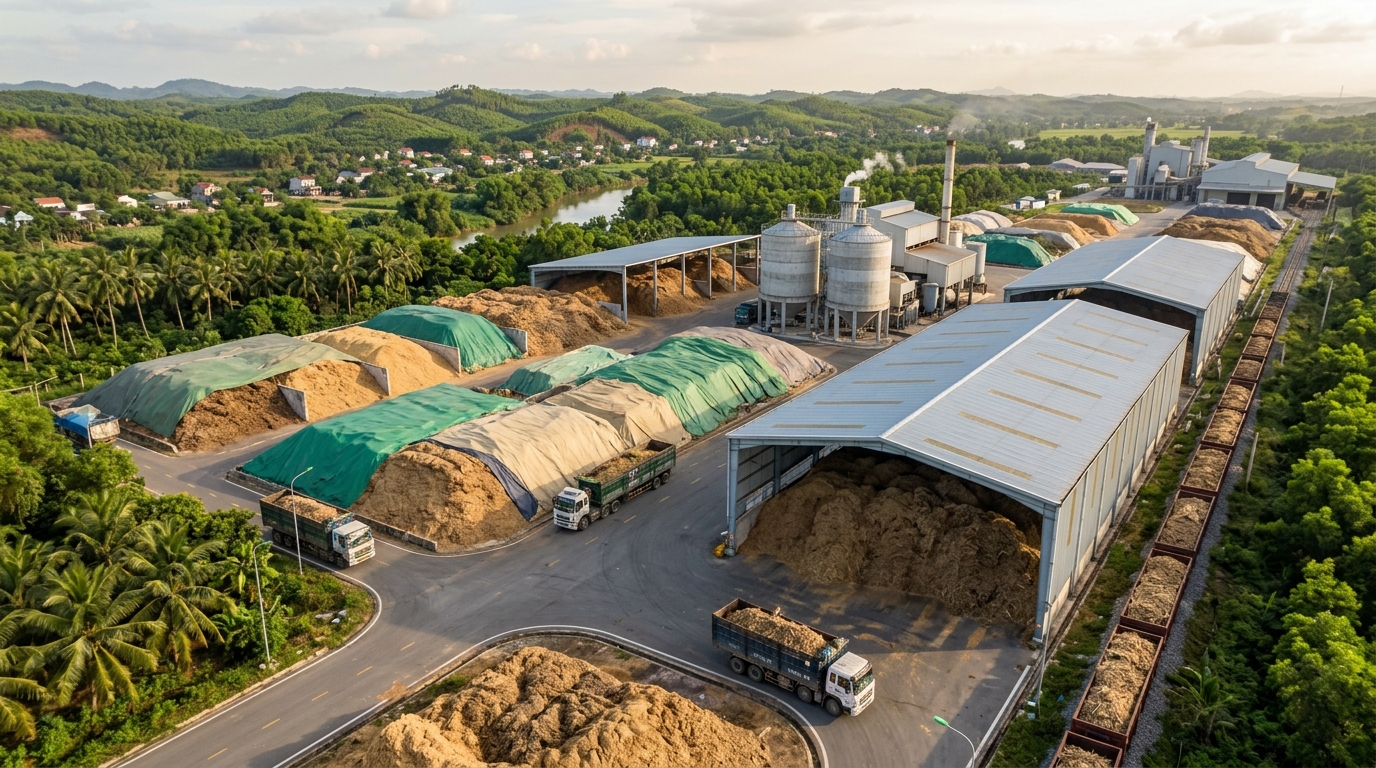
The year-round high temperature and humidity in Southern Vietnam are well-suited for stockpiling fuel — if you have sufficient storage capacity. I usually advise clients to identify at least 2–3 primary suppliers and keep 1–2 backup suppliers on standby. Sign long-term contracts with clear terms on pricing, volume, and quality, along with penalty clauses for non-compliance. In addition, partnering directly with agricultural processors to source agricultural by-products is another effective way to gain more control over your supply.
Photo: A large-scale biomass fuel storage facility is meticulously sheltered, ensuring a stable supply.
Basic Comparison: Coal-Fired Boiler vs. Biomass Boiler
The choice between a coal-fired boiler and a biomass boiler (biomass steam boiler) depends on many factors, from initial capital investment and operating costs to environmental regulations. Below is a comparison of the key points:
Criteria
Coal-Fired Boiler
Biomass Boiler (Biomass Steam Boiler)
Fuel
Coal (fines, lumps)
Rice husks, sawdust, coffee husks, pellets
Fuel Cost
More stable, but can rise with global markets
Seasonal and local supply fluctuations; vulnerable to price squeezing without contingency planning
Initial Capital Cost
Generally lower
Generally higher due to more complex firebox technology (chain grate, fluidized bed)
Operating Cost
Lower (excluding environmental compliance costs)
Can be higher if fuel and labor are not optimized; ash handling costs are lower
Environmental Impact
High CO₂, SOₓ, NOₓ, and PM emissions
Significantly lower emissions; considered carbon-neutral
Firebox slagging, water hammer (from improper operation)
ESG Compliance Potential
Low — difficult to meet "green" standards
High — a key solution for achieving ESG compliance
The Fluidized Bed Boiler is one of the most advanced technologies for biomass boilers, enabling cleaner combustion of multiple fuel types and reducing slagging. I remember a factory owner once asking "what is a fluidized bed?" — I explained it simply: instead of burning fuel on a fixed surface like a chain grate, the fuel is blown up and suspended in hot air like a "boiling pot," enabling much more complete combustion. This is especially useful for ash and residue management.
Solutions to the Slagging (Slagging) Problem in Biomass Boilers
Slagging is a perennial problem with biomass-fired boilers, especially when burning poor-quality rice husks or sawdust with high silica and alkali content. Nothing is more frustrating than having to shut down a running boiler for manual de-slagging. Addressing this requires a combination of measures:
Choose the right fuel type: This is the most critical factor, as not all sawdust or rice husks are the same. A low ash fusion temperature (below 1,100°C) is the key. Ask suppliers for quality certification documents and, where possible, conduct random spot checks on incoming batches.
Design an appropriate firebox: For biomass fuels prone to slagging, traditional chain grate or fixed grate designs will struggle. A fluidized bed boiler is a better option, or at minimum a firebox design that incorporates an effective ash cooling zone.
Operate with correct technique: Controlling firebox temperature is critically important. Excessively high temperatures can cause ash to melt and form slag. Ensure proper ratios of primary air and secondary air supply for complete combustion without creating localized overheating. I have seen many cases where operators thought the more air the better — only to find it made slagging significantly worse.
Use anti-slagging additives: Certain special additives can be mixed into the fuel or injected directly into the firebox to modify the ash fusion point, making the ash more friable and easier to remove.
Don't forget to inspect and adjust safety valves periodically, as slagging can affect pressure and operational safety. The safety valve is the boiler's "emergency exit" — if it doesn't work properly, it is extremely dangerous.
Recommendations
Don't rush into investment: Take time to thoroughly research the biomass fuel type you intend to use and consult with experts to select the boiler technology best suited to your specific production conditions.
Operator training: Investing in proper, structured training for boiler operators is the key to maximizing efficiency and avoiding incidents such as slagging or water hammer (the phenomenon of steam violently impacting piping — heard as a hammering sound, and very dangerous).
Preventive maintenance: The saying "prevention is better than cure" always holds true for boilers. Don't wait for a breakdown before taking action. Schedule regular maintenance, check feedwater treatment (to prevent scale and deposit buildup inside the boiler), and carry out periodic descaling — this will keep the boiler running durably and save fuel.
Conclusion
Converting coal-fired boilers to biomass is an inevitable trend that brings significant environmental and economic benefits — when done correctly. However, it is not an overnight magic fix. You need thorough preparation in terms of fuel supply, technology, and above all, operational expertise, to turn the "ESG solution" into a genuine competitive advantage rather than falling into a trap of costs and breakdowns. We — with over a decade of industry experience — are always ready to listen and walk this journey with you.
CONTACT INFORMATION:
Company: HONG NHUT THERMAL & REFRIGERATION ENGINEERING CO., LTD Hotline/Zalo: 0961546854 Email:[email protected] Website:https://hongnhut.com/ Address: 117A Binh Thoi Street, Phu Tho Ward, Ho Chi Minh City Factory Address: 150C Ho Hoc Lam Street, An Lac Ward, Ho Chi Minh City